
Customer service work does not begin and end with answering a customer’s question. Before an employee can resolve an issue, they may need to locate an earlier conversation, check service information, understand the customer’s requirement and identify the correct department. After the interaction, there may be notes to update, follow-up messages to send and unresolved matters to track.
When these responsibilities are repeated across dozens or hundreds of interactions, the workload can become difficult to manage. Employees may spend as much time on administrative activities and information searches as they do helping customers. During busy periods, this can leave less time for complicated requests that need careful attention.
Hiring additional employees may be one way to increase capacity, but it does not address every source of unnecessary work. Businesses also need to examine how customer service tasks are organised and where technology can reduce repeated manual effort.
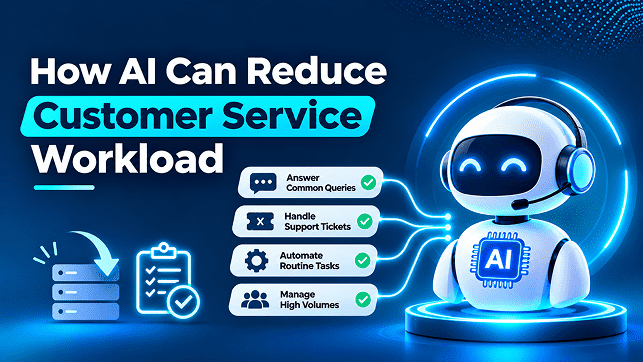
Artificial intelligence (AI) can support this improvement. It can help handle selected routine interactions, retrieve relevant information, assist employees during conversations and reduce some of the work involved in recording and reviewing customer interactions.
For businesses in Singapore, Malaysia and across Asia, the opportunity is not simply to make employees handle more conversations. It is to remove avoidable tasks so they can spend more time understanding customer needs and resolving issues properly.
The Work Behind Every Customer Interaction
A customer may see a short phone call or message, but employees often complete several activities around that interaction. These supporting tasks can accumulate throughout the day.
Consider a customer contacting a service provider about an issue. The employee may need to:
- Understand the customer’s problem and ask for missing details.
- Search internal documents for the correct procedure.
- Check whether the same customer has contacted the business previously.
- Identify the department responsible for the request.
- Explain the next steps and record the interaction.
- Arrange a follow-up if the issue cannot be resolved immediately.
Each activity may be necessary, but not all of them require an employee to perform every step manually.
The following assessment can help businesses recognise where workload builds up.
| Work area | Repeated employee effort | Where AI may assist |
| Initial enquiries | Answering common questions | Responding to selected routine enquiries |
| Information searches | Looking through documents and service details | Finding relevant approved information |
| Call handling | Identifying the reason for a call | Understanding enquiry intent and supporting routing |
| Conversation records | Writing notes after interactions | Generating draft summaries |
| Follow-up preparation | Organising action points and next steps | Extracting tasks and preparing follow-up information |
| Service reviews | Manually examining conversations | Identifying patterns across supported interaction records |
This assessment is important because the biggest workload problem may not be the customer conversation itself. It may be the collection of small tasks surrounding it.
Five Areas Where AI Can Take Pressure Off Customer Service Teams
1. Let Routine Enquiries Be Handled Without Requiring an Employee Every Time
Customer service teams frequently receive questions about operating hours, service information, general procedures, locations and other published business details.
When employees answer these questions individually, the same information must be retrieved and explained repeatedly. An AI-powered assistant can handle selected questions by using approved business information to provide relevant responses.
For example, a customer visiting a service provider’s website may ask which services are available or how to submit an enquiry. An AI assistant can explain the published information and direct the visitor towards the appropriate page or contact channel.
This allows employees to concentrate on requests that require personal attention, clarification or a decision.
However, routine automation works only when the information behind the response is accurate. Questions involving individual circumstances, confidential records or unconfirmed availability should follow the appropriate verification or human-support process.
2. Reduce the Time Employees Spend Searching for Answers
Employees cannot always remember every service detail, policy or internal procedure. They may need to move between documents, knowledge resources, customer records and internal systems before responding.
This searching creates interruptions, particularly when an employee is handling several different types of enquiries.
AI-assisted information retrieval can help by identifying relevant information from approved sources and presenting it to the employee during an interaction.
For instance, when a customer asks about a particular service procedure, an AI assistant may help the employee locate the relevant internal guidance rather than manually searching through several documents.
The employee remains responsible for checking the information and deciding how to apply it to the customer’s situation. The value comes from reducing the effort required to find useful information, not removing the employee’s responsibility.
3. Make Call and Conversation Documentation Less Manual
Customer interactions often create documentation work. Employees may need to record the customer’s concern, the information provided, actions taken and any outstanding requirements.
If these notes are written entirely by hand after every interaction, the administrative workload can grow quickly.
AI-powered conversation summarisation can help by converting supported call or chat records into draft summaries. These may include the main issue, important discussion points and possible follow-up actions.
An employee can review the summary, correct missing details and update the relevant record through an approved integration.
This is particularly useful when a business handles a large number of conversations and needs consistent documentation. It can also help the next employee understand the background when an enquiry is transferred.
AsiaTel’s AI Post-Call Analysis is relevant to businesses exploring AI-based analysis of voice interactions. The precise documentation and reporting capabilities should be confirmed against the selected service configuration.
4. Help Customers Reach the Right Support Route
When a customer contacts the wrong department, employees may need to transfer the interaction or explain where the customer should go. Repeated transfers can create additional work for staff and frustration for customers.
AI can help identify the likely purpose of an enquiry and support a more suitable routing process, where the necessary communication platform and integrations are available.
For example, a customer calling a business may need help with a technical issue rather than a general service enquiry. An AI-enabled voice interaction can identify the stated requirement and guide the call according to configured routing rules.
Businesses can explore AI Voice Agent services when assessing how voice-based AI may support selected customer interactions.
This should work alongside an organised communication environment. A suitable contact centre solution can help businesses manage incoming calls and direct interactions towards the relevant teams, depending on the platform’s supported capabilities.
5. Identify Repeated Service Problems Earlier
Customer service employees may repeatedly deal with the same underlying issue without having an easy way to see the overall pattern.
For example, several customers may contact a business about unclear instructions, a recurring service problem or a process that is difficult to complete. Each employee handles an individual interaction, but the repeated cause may remain unnoticed.
AI-assisted conversation analysis can help businesses examine supported interaction records and identify recurring subjects, common concerns or areas that may require attention.
Managers can use these observations to review customer information, improve internal procedures or address a problem that is generating unnecessary enquiries.
This does not mean that AI can determine the root cause of every complaint automatically. Findings should be checked against the actual cases and operational information before changes are made.
Not Every Task Should Be Automated
Reducing workload does not mean transferring every responsibility to AI. Some tasks involve judgement, empathy, approval or access to sensitive information. Automating these without appropriate controls can create additional problems.
A more useful approach is to decide how much responsibility AI should have for each type of work.
| Task | Appropriate AI involvement | Employee responsibility |
| Sharing published business information | Provide an approved answer | Review exceptions or unclear information |
| Searching internal guidance | Retrieve relevant material | Confirm its suitability |
| Preparing conversation notes | Generate a draft summary | Check accuracy and update records |
| Identifying enquiry categories | Suggest a category or route | Handle uncertain or unusual cases |
| Handling customer complaints | Capture initial details where appropriate | Understand the concern and manage resolution |
| Making sensitive account decisions | Provide general process guidance only, if approved | Follow authentication and authorised decision procedures |
For example, AI may help prepare a summary of a customer complaint, but an employee should assess the circumstances and decide how it should be resolved.
Similarly, an automated assistant should not access confidential customer information or make account changes unless secure integrations, authentication and the required permissions are in place.
The objective is to reduce repetitive effort while preserving human responsibility for important decisions.
How to Find the Right Tasks to Automate First
Businesses sometimes begin with the technology they want to introduce rather than the work they want to improve. This can lead to an AI implementation that looks useful but does not address the team’s main workload problems.
A task-based assessment offers a better starting point.
Look for work that happens repeatedly: Identify activities employees perform during many customer interactions, such as answering standard questions, locating documents or preparing routine notes.
Check whether the process follows clear rules: Tasks with defined information sources and predictable steps are generally easier to assess for automation than work involving individual judgement.
Understand the consequences of mistakes: A wrong answer about general operating hours has a different impact from an incorrect instruction involving a customer’s financial or confidential information.
Check the systems involved: Determine whether the AI solution can access the approved information or connect to the relevant communication and customer-management tools. Do not assume that integration is available without checking.
Ask employees where time is being lost: The people handling customer interactions often know which administrative activities interrupt their work and which processes cause repeated delays.
The following prioritisation guide can help managers compare possible starting points.
| Assessment factor | Strong starting point | Needs further review |
| Frequency | Happens regularly | Occurs rarely |
| Process | Follows clear steps | Depends on individual judgement |
| Information | Available in approved sources | Scattered, outdated or unavailable |
| Risk | Low-risk information or preparation task | Sensitive decision or account action |
| Integration | Supported by existing systems | Requires significant technical changes |
A business can begin with one or two suitable tasks, evaluate the results and expand gradually.
What Changes for Employees When AI Is Introduced?
The impact of AI should be considered from the employee’s perspective, not only from management’s operational targets.
A well-designed system can change how employees spend their working time. Instead of repeatedly searching for standard information, they may receive relevant guidance more quickly. Instead of writing every conversation summary from scratch, they may review an AI-generated draft. Instead of handling every basic question manually, they may focus on customers whose needs require personal assistance.
However, these improvements depend on how the technology is introduced.
Employees need to understand which tasks AI handles, how to verify its suggestions and when to ignore or correct an automated result. They should also have a clear process for reporting inaccurate answers or workflow problems.
If employees must constantly correct AI-generated information, repeat work that the system failed to complete or manage a confusing handover, the workload may simply move from one task to another.
For this reason, staff feedback should be included in the implementation and review process. Employees should be able to identify whether the technology is genuinely making their work easier.
Measuring Workload Reduction Beyond Response Speed
A faster response does not always mean that the service team has less work. A customer might receive an immediate automated answer but still need to contact an employee because the original issue was not resolved.
Businesses should therefore evaluate the amount of work removed, the quality of the remaining interactions and the effort required to maintain the AI system.
Some useful measures include:
- Manual documentation time: How much time employees spend preparing notes and updating records.
- Information search time: Whether employees can locate approved answers more easily.
- Repeat contact levels: Whether customers need to contact the business again about the same unresolved matter.
- Escalation quality: Whether requests requiring employees reach the appropriate team with useful context.
- Employee correction effort: How often staff need to fix inaccurate automated responses or summaries.
- Customer feedback: Whether the new process is clear and helpful.
- Work distribution: Whether employees have more time available for complex cases and personal assistance.
It is useful to record the existing workload before introducing AI. Businesses can then compare similar periods after implementation and consider changes in enquiry volume, staffing and service conditions.
Research and industry guidance also highlight the value of using AI for agent assistance, information retrieval, interaction summaries and routine self-service rather than expecting full automation to solve every service challenge.
A Practical Example: Improving the Workday of a Customer Service Team
Consider a company that provides several business services and receives enquiries through phone calls and its website.
Its employees spend time answering general questions, searching for service information, transferring calls and writing notes after conversations. When several requests arrive together, the team struggles to balance new enquiries with existing follow-ups.
Instead of introducing one large automation project, the company could address the workload in stages.
First, it could make approved general information easier for customers to access through an AI-supported channel. Next, it could examine whether AI-assisted information retrieval would help employees during more complicated conversations. It could then assess whether call summaries would reduce manual documentation work.
After each change, the company would review employee feedback, customer experience and the time spent on the relevant tasks.
This approach does not assume that AI can resolve every customer issue. It focuses on removing specific sources of repeated effort while keeping employees responsible for the parts of service that need their experience.
Building a Customer Service Operation Where Employees Can Focus on People
Customer service teams need time to listen, understand individual circumstances and resolve problems. When too much of their day is spent repeating standard information, searching for documents and preparing routine records, those important responsibilities can become harder to manage.
AI offers businesses ways to reduce some of this supporting work. It can handle selected routine interactions, assist employees with information retrieval, prepare conversation summaries and help identify patterns across customer interactions.
The most effective approach is to begin with the tasks that create unnecessary effort, not to automate everything at once. Businesses should also maintain accurate information, review AI-generated outputs, protect customer data and provide a clear route to human assistance.
AsiaTel’s AI capabilities, including AI Voice Agent services and AI Post-Call Analysis, are relevant options for organisations assessing how AI can support customer interactions and conversation review.
Ultimately, reducing customer service workload is not about asking employees to work faster or removing the human element from support. It is about making everyday processes more manageable so employees can devote their attention to the customers and situations that need them most.